Surprising Sarajevo
An eight hour detour inland from the newly formed Montenegro lies Sarajevo in the newly formed Bosnia Herzegovina. Sarajevo featured heavily in the media coverage of the last Balkans conflict and we couldn’t miss the opportunity to put some meaning behind those vague memories of people running for cover and shells exploding in city streets. Like most people our age we had no idea of the reasons behind the conflict. After a week in the country we still found it very difficult to understand how a country could be split in 2 (or 3) leaving former friends and neighbours to slaughter each other in the name of nationalism (or was it religion). A local guide in Sarajevo put it this way, “If you fully understand the reasons behind latest Balkan conflict then you are as evil as the people who orchestrated and perpetrated it.” One thing was clear, the war is yet another example of the ability of powerful leaders and their propaganda to brainwash their followers into performing the most terrible crimes against their fellow human beings.
 Aside from the war, we discovered in Sarajevo a
  modern, clean, vibrant and cosmopolitan city. A city in 3 parts, it’s divided between an old Turkish quarter, a newer Austro-Hungarian area and the modern “new city“. And to quote Harris our tour guide again, “it’s the three parts that makes the city special.” Wander the skinny cobbled streets of the old Turkish quarter flanked by tin smiths selling their coffee sets (See photo left) or linger over a latte at one of the hundreds of cafes that take over the entire streets in the Austrian section. The Austrian section (built by the Austro-Hungarian empire) feels a lot like the CBD in Melbourne, just with less cars and more cafes. Sarajevo was given street lighting by the Austrians even before Vienna, there were doubts about the safety of electricity and it was deemed safer to try it out on the colonies first.
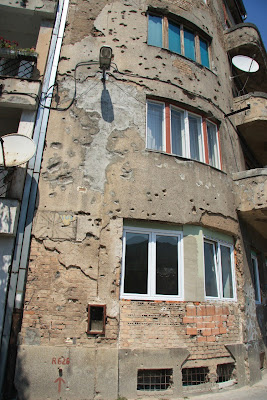
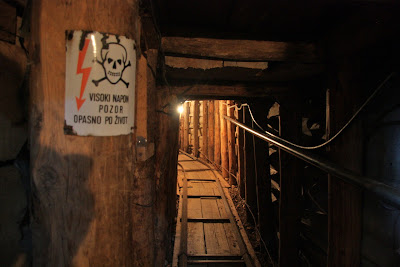
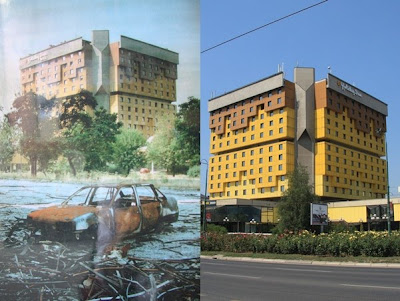
The place is almost fully rebuilt and there are few reminders of the dark times in the 1990’s. Sniper alley (see photo left) remains with its bullet hole ridden buildings, and the yellow Holiday Inn where journalists covering the conflict took refuge still stands tall in central Sarajevo. The only other major reminder is the tunnel museum, a small house on the outskirts of town that hid the entrance to a tunnel that connected Sarajevo to the outside world. An ingenious piece of engineering, the 800 metre long tunnel (see photo below) was built by Bosnian’s trapped in Sarajevo as a way of getting supplies into the town during the 3 and a half year siege. They tunnelled under the international airport (held by the neutral U.N.) and out into the mountains where the Serbian Military found it difficult to retain control. Young men carried 60kg packs back from the mountains, through the tunnel, then braved the sniper ridded streets of Sarajevo to bring food to their families. The small photo collection of the museum gives a rare insight into life in the city under siege.

 Stayed: Hostel City Centre (great location, great facilities, a fantastic hostel, one of the best we’ve stayed at so far).
Toured: Harris city tour (run by the energetic local Harris, a great tour that looks into Sarajevo’s history and is not afraid to answer the difficult questions)
The infamous corner that sparked off the 1st World War.
The Holiday Inn, left during the war; and now.
 Aside from the war, we discovered in Sarajevo a
  modern, clean, vibrant and cosmopolitan city. A city in 3 parts, it’s divided between an old Turkish quarter, a newer Austro-Hungarian area and the modern “new city“. And to quote Harris our tour guide again, “it’s the three parts that makes the city special.” Wander the skinny cobbled streets of the old Turkish quarter flanked by tin smiths selling their coffee sets (See photo left) or linger over a latte at one of the hundreds of cafes that take over the entire streets in the Austrian section. The Austrian section (built by the Austro-Hungarian empire) feels a lot like the CBD in Melbourne, just with less cars and more cafes. Sarajevo was given street lighting by the Austrians even before Vienna, there were doubts about the safety of electricity and it was deemed safer to try it out on the colonies first.
The place is almost fully rebuilt and there are few reminders of the dark times in the 1990’s. Sniper alley (see photo left) remains with its bullet hole ridden buildings, and the yellow Holiday Inn where journalists covering the conflict took refuge still stands tall in central Sarajevo. The only other major reminder is the tunnel museum, a small house on the outskirts of town that hid the entrance to a tunnel that connected Sarajevo to the outside world. An ingenious piece of engineering, the 800 metre long tunnel (see photo below) was built by Bosnian’s trapped in Sarajevo as a way of getting supplies into the town during the 3 and a half year siege. They tunnelled under the international airport (held by the neutral U.N.) and out into the mountains where the Serbian Military found it difficult to retain control. Young men carried 60kg packs back from the mountains, through the tunnel, then braved the sniper ridded streets of Sarajevo to bring food to their families. The small photo collection of the museum gives a rare insight into life in the city under siege.


 Stayed: Hostel City Centre (great location, great facilities, a fantastic hostel, one of the best we’ve stayed at so far).
Toured: Harris city tour (run by the energetic local Harris, a great tour that looks into Sarajevo’s history and is not afraid to answer the difficult questions)
The infamous corner that sparked off the 1st World War.
The Holiday Inn, left during the war; and now.
Comments