Majestic Mostar (and Majdas hostel)
Completely unknown to us before we started travelling the Balkans, Mostar proved to be a hidden gem. The war took a completed different trajectory here when the Bosnian Croats turned on their former allies the Bosnian Muslims. Former friends became enemies overnight and the slaughter of innocents continued, only the aggressor changed.

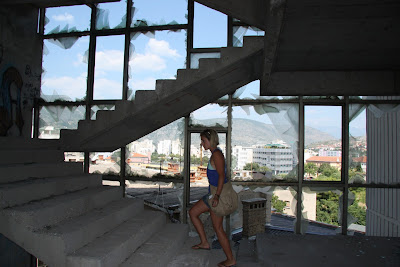
Mostar also shows much more tangible evidence of the conflict with many buildings riddled with bullet holes or still lying in rubble. The former bank stands guttered, its concrete and steel walls dotted with thousands of bullet holes. On the first floor some of the wooden walls of the bank’s offices remain, while the ground is littered with personal loan and account documents. Higher floors reveal its war time use, with large piles of spent sniper shells near small holes in the war. The bank was a favourite sniper spot just back from the front line. Nationalist (pro-segregation) graffiti covers the walls next to messages about peace and co-operation. The place is a living museum whose days are no doubt numbered.
The locals seem keen to forget the war and rebuild the city as fast as possible. The racial tensions behind the war though, have not gone away, they’re just harder to see. Toeing the nationalistic Serbian, Muslim or Croat line is expected depending on where you live and work and certain areas of town will not sell products made in or associated with mainly Muslim Sarajevo. Tourists, especially backpackers, have been doing their bit to reveal the childishness of this policy by demanding Sarajevo made beer wherever they go.
 The main attraction in Mostar is the bridge, a replica (the original was destroyed by Croat shelling in 1995) of the beautiful stone bridge built in 1556. It slender shape and white stone have earned it the nickname, the petrified moon. Towering 26 meters above the azure blue Neretva river, the bridge has been bringing tourists to Mostar for centuries. Its
 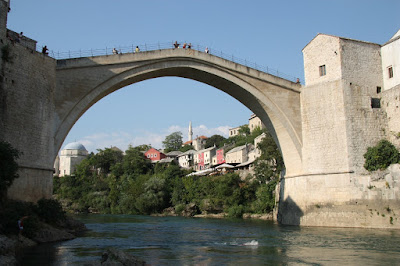 been bringing divers here too, to plunge off it’s apex into the freezing waters below. Originally locals would make the jump for a few cigarettes or to impress a local girl, but they’ve caught up with the times and now they’re after currency, and hard currency at that. Forget your convertible marks, these guys want Euros, somewhere near sixty for a jump and three hundred for a dive. After a small mishap (or slip causing me to slide down a near vertical cliff) while attempting a 5m jump into water at some nearby waterfalls, the bridge was definitely out for me. A few friends however were determined to at least give it some serious thought. Greg and David, brothers from Melbourne who we’d followed (or who had followed us) since our first meeting in Budva, Montenegro were keen to try the 10m platform next to the bridge and then possibly the bridge itself. We all jumped into the water below the bridge to test the temperature and Kel and I immediately got out. At 9 degrees Celsius it’s not exactly tropical. The boys leaped off the 10m platform after some time for courage building but left it at that. Thus we would all leave Mostar without seeing the famous leap.
Although the bridge is stunning, backpackers come here for a different reason, the Majdas hostel and tour. Brother and sister team Majdas and Bata run a hostel and tour respectively that puts Mostar on the Backpacker map. The hostel is fantastic, run by the ever helpful Majdas, and the tour is a once in a trip experience. 14 hours long, led by the crazily energetic Bata the tour takes in all the sights in Mostar and the surrounds and delves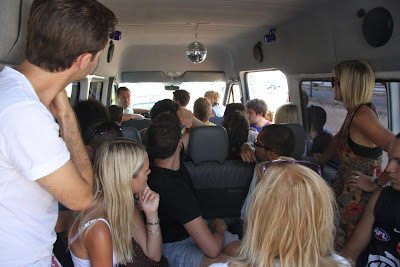 deep into the recent conflict. The only tour to tell the real story, as Bata claims the official tour guides are muzzled in order to keep the peace. Bata talks truthfully about what it was like to be in Mostar during the war including own brushes with death and the generosity of friends and strangers who risked their lives to save him. A true adventure that involves both physical and mental challengers, the tour was certainly a highlight of our week in Bosnia Herzegovina. (Photo - Bata tells his story to the full minibus (with mirrorball))

Mostar also shows much more tangible evidence of the conflict with many buildings riddled with bullet holes or still lying in rubble. The former bank stands guttered, its concrete and steel walls dotted with thousands of bullet holes. On the first floor some of the wooden walls of the bank’s offices remain, while the ground is littered with personal
 loan and account documents. Higher floors reveal its war time use, with large piles of spent sniper shells near small holes in the war. The bank was a favourite sniper spot just back from the front line. Nationalist (pro-segregation) graffiti covers the walls next to messages about peace and co-operation. The place is a living museum whose days are no doubt numbered.
The locals seem keen to forget the war and rebuild the city as fast as possible. The racial tensions behind the war though, have not gone away, they’re just harder to see. Toeing the nationalistic Serbian, Muslim or Croat line is expected depending on where you live and work and certain areas of town will not sell products made in or associated with mainly Muslim Sarajevo. Tourists, especially backpackers, have been doing their bit to reveal the childishness of this policy by demanding Sarajevo made beer wherever they go.
 The main attraction in Mostar is the bridge, a replica (the original was destroyed by Croat shelling in 1995) of the beautiful stone bridge built in 1556. It slender shape and white stone have earned it the nickname, the petrified moon. Towering 26 meters above the azure blue Neretva river, the bridge has been bringing tourists to Mostar for centuries. Its
  been bringing divers here too, to plunge off it’s apex into the freezing waters below. Originally locals would make the jump for a few cigarettes or to impress a local girl, but they’ve caught up with the times and now they’re after currency, and hard currency at that. Forget your convertible marks, these guys want Euros, somewhere near sixty for a jump and three hundred for a dive. After a small mishap (or slip causing me to slide down a near vertical cliff) while attempting a 5m jump into water at some nearby waterfalls, the bridge was definitely out for me. A few friends however were determined to at least give it some serious thought. Greg and David, brothers from Melbourne who we’d followed (or who had followed us) since our first meeting in Budva, Montenegro were keen to try the 10m platform next to the bridge and then possibly the bridge itself. We all jumped into the water below the bridge to test the temperature and Kel and I immediately got out. At 9 degrees Celsius it’s not exactly tropical. The boys leaped off the 10m platform after some time for courage building but left it at that. Thus we would all leave Mostar without seeing the famous leap.
Although the bridge is stunning, backpackers come here for a different reason, the Majdas hostel and tour. Brother and sister team Majdas and Bata run a hostel and tour respectively that puts Mostar on the Backpacker map. The hostel is fantastic, run by the ever helpful Majdas, and the tour is a once in a trip experience. 14 hours long, led by the crazily energetic Bata the tour takes in all the sights in Mostar and the surrounds and delves
 deep into the recent conflict. The only tour to tell the real story, as Bata claims the official tour guides are muzzled in order to keep the peace. Bata talks truthfully about what it was like to be in Mostar during the war including own brushes with death and the generosity of friends and strangers who risked their lives to save him. A true adventure that involves both physical and mental challengers, the tour was certainly a highlight of our week in Bosnia Herzegovina. (Photo - Bata tells his story to the full minibus (with mirrorball))
Comments